Why Summer Heat Causes Outdoor AC Units to Shut Down
Why Summer Heat Causes Outdoor AC Units to Shut Down
Phoenix summers push air conditioning equipment harder than almost any major metro in the country. When outdoor temperatures climb past 110 degrees and the heat radiating off stucco walls, gravel yards, and concrete pads pushes the area around the condenser even higher, the outdoor unit can reach a point where it shuts down to protect itself or simply fails under stress. That is why Emergency AC Repair becomes so common across Phoenix, AZ every June, July, and August. A system that seemed fine in May can stop cooling fast once the Sonoran Desert starts delivering full summer load.
Across Maricopa County, the outdoor section of an AC system faces a punishing mix of extreme ambient heat, direct sun exposure, monsoon dust, electrical strain, and long run times. In neighborhoods like Arcadia 85018, Biltmore 85016, Ahwatukee 85044, Desert Ridge 85050, and North Phoenix 85032, technicians see the same pattern every summer. The indoor thermostat calls for cooling, the blower may still run, but the outdoor condensing unit either struggles, trips a safety control, or shuts off completely. In those moments, homeowners usually start searching for air conditioning repair, ac repair phoenix, or Emergency AC Repair because the issue stops being inconvenient and becomes urgent.
The outdoor unit is where heat leaves the house. It contains the compressor, the condenser coil, the condenser fan motor, and electrical parts such as the run capacitor and contactor. The run capacitor is the cylindrical electrical component inside the outdoor condensing unit that stores and releases the energy pulse needed to help start and run the compressor and fan motor each time the AC cycles on. In Phoenix heat, that small part lives a much harder life than it would in a milder climate.
Phoenix heat changes how AC equipment fails
Phoenix sits in ASHRAE climate zone 2B, which is hot and dry. Design cooling temperatures in the metro typically land in the 110 to 117 degree range depending on elevation and location. That matters because residential AC systems are designed around expected load, not endless reserve capacity. Once outdoor air gets extreme and the pad temperature around a west-facing condenser rises into the 130 to 140 degree range, the system has to reject indoor heat into already brutal outdoor conditions. Every component works harder.
This is one of the most locally shareable facts about Phoenix cooling performance: west-exposure outdoor units in the Valley commonly operate in air temperatures at the equipment pad that are 15 to 25 degrees hotter than the official weather report. The sensor reading at Sky Harbor or on a weather app may say 113, but the condenser next to a block wall can be baking in 130-plus conditions by late afternoon. That thermal buildup is a major reason Emergency AC Repair calls spike in zip codes near South Mountain, Camelback East, and the I-10 corridor during heat waves.
Heat alone is not the full story. AC systems in Phoenix also run for long stretches. A properly sized unit based on a Manual J Residential Load Calculation under ACCA Standard 1 may still run many hours on a 115 degree day. A poorly sized or poorly maintained unit can run nearly nonstop. When a condenser stays under heavy electrical and mechanical load for days at a time, weak parts begin to show it.
Why the outdoor unit shuts down instead of pushing through
An outdoor AC unit does not always fail in a dramatic way. Many summer shutdowns are protective responses. The compressor can overheat and lock out. A safety switch can interrupt operation. A weak capacitor can let the motor stall on startup. The system may hum, click, or try repeatedly to start. In some cases, the thermostat still appears normal inside the home, which makes the problem look confusing to the homeowner. From the field side, the issue is often very clear once the equipment is tested under load.
The compressor is the heart of the outdoor unit. It pumps refrigerant between the indoor evaporator coil and the outdoor condenser coil. If the compressor gets too hot, internal overload protection can shut it off. That can happen because of extreme ambient heat, dirty coils, low refrigerant charge, electrical issues, or long-term strain from an undersized or incorrectly sized system. When the compressor cools down, it may try to restart, which can create an intermittent pattern that homeowners describe as an AC that works in the morning and quits in the afternoon. That exact complaint drives a large share of Emergency AC Repair calls in Phoenix every summer.
The condenser fan motor also matters. Its job is to pull air through the outdoor coil and carry heat away. If the fan motor is weak, if the fan capacitor is failing, or if the contactor is worn and not making proper electrical contact, the system loses the airflow needed to cool the compressor. Once that happens, the compressor temperature rises quickly. Many outdoor shutdowns begin with poor heat rejection rather than a full refrigerant issue.
Run capacitor failure is Phoenix’s most common summer breakdown
In the Phoenix metro, run capacitor failure is one of the most common reasons an outdoor AC unit stops turning on during peak summer. The run capacitor looks simple, but it carries a real workload. Technicians test it with a capacitance meter to see whether it is still operating within its rated range. A capacitor can appear intact and still test weak enough to cause startup failure. That is why real diagnosis matters.
High heat shortens capacitor life. On a cooler coast, a capacitor may age gradually and last longer. In Phoenix, direct sun, equipment pad heat, and repeated daily cycles put the part under much more stress. Day after day, the capacitor has to help start the compressor and fan against high head pressure, which is the elevated refrigerant pressure the system experiences when outdoor conditions are severe. Once the capacitor weakens, the unit may buzz, hesitate, or trip out. Homeowners in Maryvale 85033 and Sunnyslope 85020 often report that the system was noisy for a few days before it finally stopped cooling.
This is where Emergency AC Repair differs from a routine service call. When indoor temperature is climbing and the outdoor unit is not starting, the goal is not guesswork. The goal is live electrical testing, safe verification of the failed component, and a written flat-rate repair price before work starts.
Dirty condenser coils can steal 15 to 25 percent of cooling capacity
Phoenix monsoon season adds another local failure pattern that many homeowners underestimate. From June through September, haboob dust events blow caliche fines into outdoor condensing units. The condenser coil is the metal coil wrapped around the outside of the unit that releases heat from the refrigerant. When dust packs into that coil, airflow drops. With reduced airflow, the system cannot reject heat properly, refrigerant pressures climb, and the compressor runs hotter.
A coil packed with monsoon dust can reduce cooling capacity by roughly 15 to 25 percent until it is properly cleaned. That is a major drop in a climate where little margin exists to begin with. In practical terms, a house in Encanto or Paradise Valley Village may still get some cooling, but it can no longer pull indoor temperature down during the hottest part of the day. The system runs longer, utility bills rise, and the outdoor unit may shut down on overload. Many homeowners call for Emergency AC Repair thinking the compressor has failed, when the root problem is a severely fouled condenser coil.
Coil cleaning in Phoenix is not cosmetic. It is directly tied to system capacity and compressor survival. This is especially true near major traffic corridors like I-17, Loop 202, and SR 51, where dust and airborne debris can build up fast.
Low refrigerant and leak problems get worse in extreme summer weather
Refrigerant carries heat out of the house. If the system is low on charge because of a leak, the AC can still limp along for a while during mild weather, then fall apart when true summer arrives. That is why some homeowners say the system cooled fine in spring but cannot keep up now. In many cases, the leak was already there.
Proper diagnosis means measuring refrigerant performance, not guessing based on line temperature or vent feel. Technicians verify charge using superheat and subcooling readings. Those are field measurements that show how the refrigerant is behaving through the system. If the charge is low, the next question is where the leak is coming from. Common Phoenix leak points include the evaporator coil inside the home and the TXV valve, the thermostatic expansion valve that meters refrigerant into the indoor coil.
Low refrigerant can lead to ice on the evaporator coil, poor cooling, and eventually compressor damage. A compressor that has been forced to run hot and low on refrigerant for too long may reach the point where Emergency AC Repair becomes a much larger decision about whether repair still makes sense, especially on older R-410A equipment.
The 2026 R-454B transition changes repair decisions on older systems
Phoenix homeowners dealing with summer breakdowns in 2026 and beyond also face a refrigerant market change that matters. As of January 1, 2026, new R-410A system manufacturing ended under the EPA SNAP framework, and new equipment shifted to R-454B. R-454B is an A2L mildly flammable refrigerant with a global warming potential of 466, compared with 2,088 for R-410A. Existing R-410A systems can still be repaired and serviced, but new equipment is moving into the R-454B standard.
That does not mean every R-410A breakdown requires replacement. It does mean the repair-versus-replacement conversation becomes more serious when an older unit has a compressor issue, a major evaporator coil leak, or repeated summer shutdowns. Homeowners in Camelback East and Ahwatukee with 2016 to 2019 systems are now hitting the point where recurring heat-related failures may justify a closer look at system age, condition, and refrigerant cost exposure. Even for homes calling about Emergency AC Repair, the diagnostic result sometimes shows that a short-term repair will only buy limited time.
Any contractor handling modern refrigerants in Arizona should be working under Arizona ROC C-39 Air Conditioning and Refrigeration licensing with EPA Section 608 certified technicians. For new A2L equipment, R-454B transition training matters because tools, leak procedures, and installation standards have changed.
Oversized and undersized systems both create summer shutdown risk
Phoenix still has many homes where the original or replacement system was selected by square footage instead of a proper Manual J calculation. That creates trouble in two directions. An undersized system runs too long and may never catch up. An oversized system short cycles, which means it turns on and off too often, creating extra electrical and mechanical wear. Both problems shorten equipment life.
In newer subdivisions around Desert Ridge and older ranch homes near Biltmore, technicians still find systems that were never matched to the real load of the house. Window orientation, roof insulation, duct leakage, shade, air infiltration, and ceiling height all matter. A five-ton system chosen by rule of thumb can still be wrong for a Phoenix house. Manual J exists for a reason. In the field, poor sizing often shows up as repeated high-summer breakdowns, compressor overheating, and chronic Emergency AC Repair calls.
Another shareable Phoenix reality is that old duct systems in mid-century homes can leak a huge amount of cooled air into the attic. In parts of Arcadia and the Biltmore area, original ductwork from the 1950s through 1970s can lose 35 percent or more of supply air before it reaches the rooms. That forces the outdoor unit to run longer and hotter, making shutdowns more likely on severe afternoons.
Electrical parts suffer when the Valley power grid and weather turn rough
Summer in Phoenix is not just hot. It also brings power quality problems. Monsoon storms can trigger surges, brief interruptions, and hard restarts. Contactors, which are the heavy-duty electrical switches that send power to the outdoor unit, can pit, weld, or fail to close cleanly after years of hot-weather cycling. A damaged contactor may chatter, stick, or stop delivering proper voltage to the compressor and fan.
Thermostat issues can also mimic an outdoor unit failure. The thermostat is the control that tells the system when to turn on. If the thermostat is misreading temperature, losing communication, or dealing with a low-voltage issue, the outdoor unit may not receive a clean call for cooling. A proper Emergency AC Repair diagnosis checks the full chain, from thermostat signal to contactor function to capacitor value to compressor amperage.
Condensate safety switches can create another shutdown pattern. The condensate drain line carries water away from the indoor coil. If algae or sludge clogs the drain and a float switch trips, the system may shut off to prevent water damage. Homeowners often think the outdoor unit failed, but the shutdown actually started indoors. In Phoenix, where systems produce a lot of condensate during humid monsoon periods, this is a regular summer call.
What experienced Phoenix diagnosis looks like
Real air conditioning repair starts with testing, not assumptions. When a home loses cooling in Phoenix, the important question is why the outdoor unit shut down under actual operating conditions. The answer may involve one failed part, or it may show a chain of stress factors that built over time.
- Electrical testing of the run capacitor, contactor, voltage, and compressor amperage
- Refrigerant performance verification using superheat and subcooling readings
- Inspection of condenser coil condition, fan operation, and compressor temperature
- Airflow review including filter restriction, blower performance, and evaporator coil condition
- Control and safety check of thermostat signal, float switch status, and system protections
That process matters because the same symptom can have very different causes. Warm air from vents might mean a failed capacitor. It might mean a locked compressor. It might mean a dirty coil, low refrigerant, or a float switch trip. In a Phoenix July, lost time from misdiagnosis is expensive and uncomfortable.
Older Phoenix neighborhoods show repeat failure patterns
After more than 40 years in the Valley, certain patterns repeat by area and housing stock. Mid-century homes in Arcadia and Camelback East often have aging ductwork, older electrical service details, and replacement condensers working against attic leakage that was never corrected. Homes in Maryvale and parts of Encanto may have older package units or split systems that have spent years in direct sun with minimal maintenance. In Ahwatukee and along Loop 202, two-story homes with west-facing glass can put brutal late-day demand on the outdoor unit. Near Phoenix Sky Harbor International Airport and the South Mountain area, dust load and radiant heat can be intense.
These local patterns explain why homeowners searching ac repair near me are often dealing with more than a generic breakdown. Phoenix equipment has a specific operating environment. A contractor who works this market every day understands how monsoon dust, pad temperature, solar exposure, and long runtime interact. That is the difference between generic air conditioning repair and diagnosis that matches the desert reality.
Why emergency response matters more in Phoenix than in milder cities
In some regions, an AC outage is uncomfortable. In Phoenix, it can become unsafe fast, especially for infants, elderly residents, pets, and anyone with health conditions. A house that starts at 78 in the evening can move into the mid-80s or worse overnight if the outdoor unit stops and the home has poor insulation or major west exposure. That is why Emergency AC Repair is treated differently here than in a moderate climate.
Same-day response matters during extreme heat warnings. So does clear pricing. Homeowners dealing with an after-hours breakdown do not need vague promises or hourly surprises. They need a firm diagnosis and an upfront flat-rate repair option before the work begins. That service model is especially important during weekend failures and late-night shutdowns when families are already under stress.
When repair is still the right move, and when it is not
Many summer shutdowns are fully repairable. A failed run capacitor, a bad contactor, a clogged condensate drain, a dirty condenser coil, or a thermostat issue can often be corrected quickly once identified. In those cases, Emergency AC Repair gets the system back online without turning a repair visit into an unnecessary replacement pitch.
There are also cases where repair becomes hard to justify. If the outdoor unit has a compressor failure, if the system has a major refrigerant leak in an aging coil, if the equipment was poorly sized from the start, or if repeated breakdowns have been stacking up for multiple summers, the long-term cost picture changes. For some homeowners, that leads to a next-step conversation about ac installation, especially if the current system is older R-410A equipment near end of service life.
For Homepage replacement work in Phoenix, 2026 minimum efficiency standards matter. Split systems under 45,000 BTU in the Southwest must meet 14.3 SEER2 and 11.7 EER2 minimums. Proper equipment selection also needs Manual S and duct evaluation under Manual D principles, not just a box swap. Utility incentives may help on qualifying projects, including APS heat pump rebates up to $2,000, SRP HVAC rebates up to $1,500, and the federal Section 25C tax credit up to $2,000 for qualifying heat pumps.
What Phoenix homeowners tend to notice before the shutdown happens
Outdoor AC units rarely go from perfect to dead with no warning at all. The signs are often there first, though they can be easy to dismiss during busy summer weeks.
- The system cools in the morning but struggles after 3 PM
- The outdoor unit hums, clicks, or tries to start several times
- Air from the vents turns warmer during the hottest part of the day
- Electric bills climb while indoor temperature drifts upward
- The thermostat is calling for cooling, but the outdoor fan is not running
Those are classic warning signs behind many Emergency AC Repair calls in Phoenix. They point to stress at the condenser, not just random inconvenience.
Why local credentials and local experience matter on high-heat AC failures
When an outdoor unit shuts down during a Phoenix heat wave, the homeowner is not just hiring someone to swap a part. The homeowner is hiring judgment. Arizona requires proper licensure for residential HVAC work through the Arizona ROC C-39 Air Conditioning and Refrigeration license. Refrigerant handling requires EPA Section 608 certification. In 2026 and beyond, technicians also need current training around R-454B and related A2L practices for new equipment.
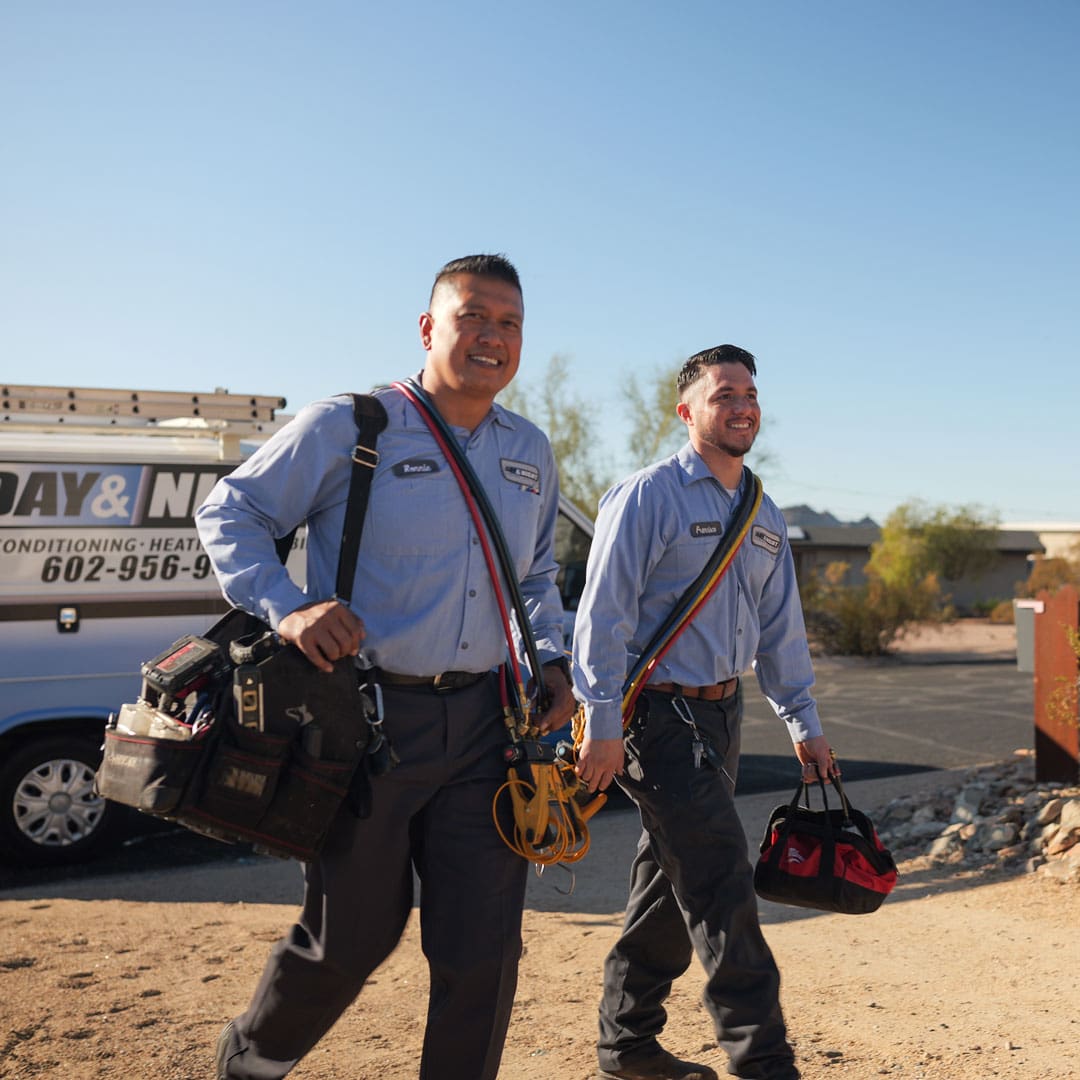
Day & Night Air Conditioning, Heating & Plumbing has worked from 3669 E La Salle St in Phoenix 85040 since 1978 and serves the full Valley, including Arcadia, Biltmore, Ahwatukee, Desert Ridge, South Mountain, and the broader Maricopa County market. That length of service matters because Phoenix failures are repetitive in very local ways. The company’s technicians see what summer does to condensers along I-10, in west-facing stucco subdivisions, and in older neighborhoods with leaky ducts and aging R-410A systems. That is also why the company’s 24/7 dispatch structure matters for true Emergency AC Repair conditions.
For homeowners weighing who to call, credibility should be visible and local. Day & Night holds Arizona ROC C-39 HVAC and ROC C-37 plumbing licensure, employs EPA Section 608 certified technicians, and has R-454B transition training in place for the post-2026 market. The company also carries a 4.9 star Google rating across more than 9,400 verified reviews, plus Google Guaranteed and BBB A+ accreditation. Those details do not cool a house by themselves, but they do show whether a contractor has the structure to respond correctly when the outdoor unit quits in 115 degree weather.
What Phoenix homeowners can expect at the point of service
The best service experience during a breakdown is calm, technical, and clear. The system should be tested under real conditions. The failed part or failing condition should be explained in plain language. The repair price should be presented before work begins. If the system has crossed into end-of-life territory, that should be explained honestly as well. Phoenix homeowners do not need sugar-coated guesses during a heat emergency. They need a technician who can separate a capacitor problem from a compressor problem, a dirty coil from a refrigerant leak, and a one-time repair from a pattern that is likely to repeat.
That is especially important for homeowners who started with a search for ac repair phoenix, air conditioning repair, or ac repair near me and are now facing a same-day decision. Extreme heat shrinks the margin for trial and error. A written flat-rate diagnosis and repair path is the right way to handle a true summer shutdown.
When the outdoor unit quits in Phoenix
Summer heat causes outdoor AC units to shut down because every stress point inside the system rises at once. Refrigerant pressure climbs. Electrical parts run hotter. Dust blocks airflow. Compressors overheat. Weak capacitors finally fail. Mis-sized systems run too long. Older coils leak under load. What looks sudden to the homeowner is often the final stage of a problem that Phoenix heat exposed.
For homes anywhere in Phoenix and Maricopa County, from 85018 to 85044 to 85050, Day & Night Air Conditioning, Heating & Plumbing provides Emergency AC Repair with 24/7 emergency service, same-day service availability, and upfront flat-rate pricing before work begins. The company has served the Valley since 1978, operates from Phoenix 85040, and brings Arizona ROC C-39 HVAC licensing, EPA Section 608 certified technicians, and R-454B transition training to every call. Homeowners who need Emergency AC Repair can call (602) 492-9656 to schedule service through Day & Night Air Conditioning, Heating & Plumbing.
Phoenix, AZ 85040